
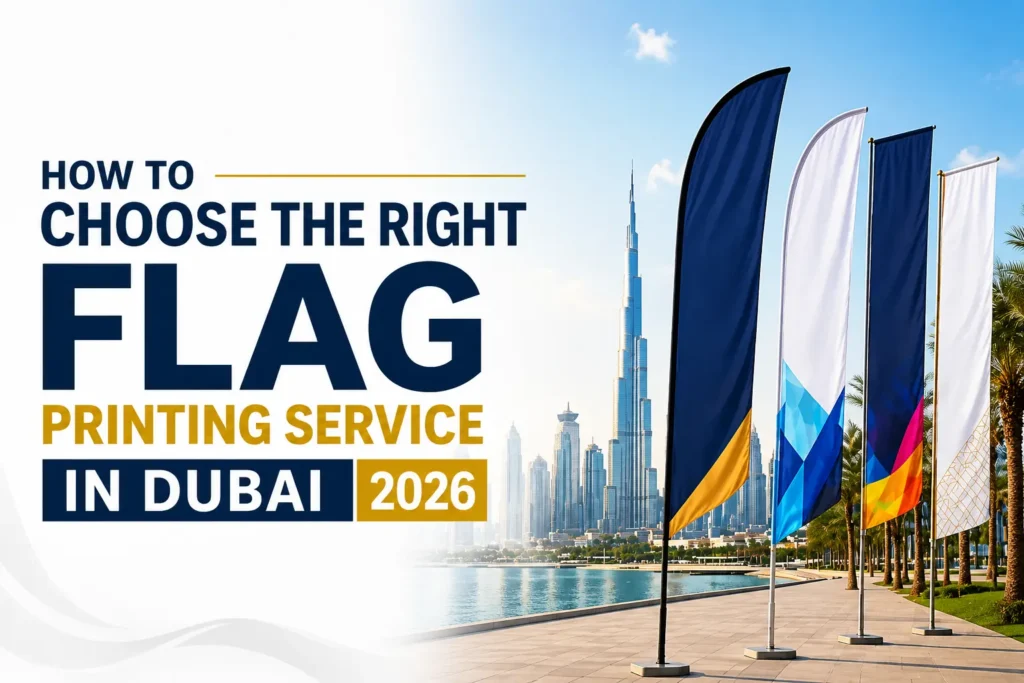
At first, ordering a flag may sound simple. You choose a size, send your logo and ask for a price. But once you start comparing quotes, you may notice that one supplier includes only printed fabric while another includes the pole, base and finishing as well. This is why choosing the right flag printing service in Dubai needs a little more thought. The place where the flag will stand, the weather around it, how far people will see it from and how often you plan to use it can all affect the final choice. A flag for an indoor exhibition is not the same as one placed outside a showroom for several weeks. The aim of this guide is to help you compare options clearly before placing an order.
Start With Where the Flag Will Be Used
The first thing to decide is not the colour or size.
It is the location.
A flag used inside a mall or exhibition hall has different needs from one placed outside a shop or beside a road. For flag printing in Dubai, tell the supplier whether the flag will be used indoors, outdoors, at an event, near a showroom or around a retail entrance. This helps them suggest the right fabric, pole and base. You should also mention how long the flag will stay in that place. A one-day event may need a different setup from a flag used every day.
Choose a Flag Style That Fits the Space
Flag shape is not only a design choice. It changes how much space you have for text and how the graphic appears when installed.
Feather Flags
Feather flags have a tall shape that works well around entrances, showrooms, events and promotional spaces. Their height makes them easy to notice without requiring a wide installation area. They are useful for short messages such as a business name, product name or promotion.
Teardrop Flags
Teardrop flags have a curved, tensioned shape that keeps more of the graphic open rather than allowing the fabric to hang freely. They are commonly used for outdoor promotions, sporting events and business entrances.
L-Shaped and Rectangular Flags
Businesses that need a straighter display area may prefer rectangular or L-shaped options. These advertising flags give designs more regular space, which can be useful when text or a logo does not fit naturally into a curved shape.
Table Flags
Small table flags are made for close viewing rather than outdoor visibility. They can work in reception areas, conference rooms, corporate meetings and formal events where the finish of the flag and stand can be seen from a short distance.
Ask What Fabric Will Be Used
Two flags can look similar in a photo but use very different materials. This is why you should ask about the fabric before comparing prices.
- Polyester is commonly used for custom flag printing because it is lightweight and suitable for fabric printing.
- Knitted polyester is often used for outdoor promotional flags because it moves easily in the air and works well with common print methods.
Do not accept a vague answer such as “high-quality fabric.” Ask what type of polyester is being used and whether it is recommended for indoor or outdoor use.
Think About Dubai Weather
Outdoor flags in Dubai may be exposed to strong sunlight, heat, dust and wind. That means your outdoor flags should be produced with materials made for repeated external use. No fabric will stay new forever, especially if it remains outdoors for long periods. The useful question is how the material will perform under the conditions where you plan to install it. Ask whether the fabric and ink are suitable for outdoor use and how the flag should be stored when it is not needed. Proper storage can also help extend its usable life.
Ask How Your Custom Flag Will Be Printed
The printing method matters just as much as the fabric.
Dye sublimation printing is commonly used with polyester flag material. Instead of creating a thick printed layer over the surface, the process transfers the colour into the polyester fibres.
This allows the fabric to remain lightweight and flexible. It is useful for flags because the material needs to move naturally while still showing the printed design. If a supplier only tells you that your flag will be “digitally printed,” ask which process will be used for the selected fabric.
Decide Between Single and Double-Sided Flags
This is one of the most common points of confusion. With many single-sided flags, the design can still be seen from the back because the colour passes through the fabric. However, the artwork usually appears mirrored. This may be fine if your design is mainly a logo or simple shape.
When Should You Choose Double-Sided?
Double-sided flag printing makes more sense when text must read correctly from both directions. It can also work well when people approach the flag from two different sides.
Double-sided flags usually use more material and may be heavier than single-sided ones. So they are not always necessary. Ask yourself whether the reverse side really needs to be read before paying more for it.
Choose a Flag Base for the Surface Below It
The base is one of the most important parts of the setup. A well-printed flag is not useful if it cannot stand properly where you want to place it.
Cross Base
A cross base can work on smooth, flat surfaces and is commonly used for exhibitions, malls, showrooms and indoor promotions. Extra weight may be added where appropriate.
Water Base
A water-filled base can be transported empty and filled once it reaches the location. This can make it useful for temporary promotions where the setup needs more weight while remaining movable.
Ground Spike
A spike base is designed for suitable soft ground such as soil or grass. It would make little sense on a tiled exhibition floor, which shows why the location should be discussed before ordering the hardware.
Heavier Outdoor Bases
Certain paved or more exposed outdoor locations may need heavier base systems. When ordering promotional flags, tell the printer about the surface and flag height and ask which compatible base they recommend.
Choose Size by Viewing Distance
Larger does not always mean better.
- A smaller flag may work perfectly inside an exhibition stand because visitors walk close to it.
- A taller flag may be better outside a showroom where people need to notice it from farther away.
When choosing advertising flags, think about the first point where someone should be able to see and understand the message.
That distance should guide the size. You should also consider the amount of space available around the flag. A large flag can look out of place in a narrow indoor area.
Look at Stitching and Finishing Too
Print quality is easy to notice in a sample photo. Edge finishing is easier to overlook.
Outdoor flags repeatedly move, so the edges and areas connected to the pole deserve attention.
Ask about:
- reinforced edges
- stitching
- pole sleeves
- eyelets where required
- corner finishing
Good fabric printing still needs suitable finishing to become a complete flag.
If possible, ask to see photographs of an actual finished product rather than only a close-up of printed fabric.
Keep Flag Artwork Simple
A flag is not a brochure. Someone may see it while walking past a store, entering an exhibition or travelling past a promotional area. They do not have time to read several lines of small text.
For feather flag printing, designs usually benefit from a clear logo, short message and strong contrast. Avoid trying to add your full service list, several phone numbers, email address, social accounts and a paragraph about the company.
Design for the Shape
Artwork should also follow the actual shape of the flag. Curved feather and teardrop designs have areas near the pole sleeve and edges where important information should not sit. Ask your printer for the correct artwork template before finalising the design.
Check File Requirements Before Sending Artwork
Different printers can have different artwork rules. Some may ask for PDF files while others prefer AI or EPS. High-resolution artwork is usually important for larger flags because small images may lose quality when enlarged.
Before sending your files, confirm:
- final size
- preferred file format
- colour mode
- image resolution
- safe area
- bleed if needed
This is especially important for large format printing, where low-quality artwork becomes more noticeable. Sending the correct file from the start can also prevent delays.
Ask for a Proof Before Printing
A digital proof gives you a final chance to check the design before production begins. Look at the spelling, logo position, flag orientation and size. For custom printed flags, also check whether the artwork is single-sided or double-sided as agreed.
A proof can catch simple mistakes before they become expensive ones. If colour matching is very important to your brand, ask the printer how they manage colour on the selected fabric. Colours on fabric may not always look exactly the same as they do on a computer screen.
Compare Production Time Properly
A supplier may advertise fast production, but you still need to know when that time starts. Does it begin when you ask for a quote? Or after final artwork approval?
For urgent flag printing services, ask for the exact number of working days after artwork approval.
Also check whether the timeline includes:
- printing
- stitching
- hardware
- packing
- delivery
This is important if the flags are needed for a store opening, exhibition or scheduled event.
Check If Replacement Fabric Is Available
You may not need a completely new flag system every time your promotion changes.
For example, you might use one design for a grand opening and another for a seasonal campaign. If the pole and base are still in good condition, replacing only the printed flag fabric may be enough. Ask the supplier whether replacement graphics can be produced for the same hardware. This can make repeat campaigns easier and reduce the need to buy new poles and bases each time.
Know What Is Included in the Quote
A cheap quote can look attractive until you discover that the base and pole are not included.
Before comparing prices, ask for a clear list of what you are getting.
A complete quote may include:
- printed flag
- pole
- selected base
- carry bag
- finishing
- delivery
Some suppliers may charge separately for artwork changes or design work.
This is why comparing only the headline price of custom flags in Dubai can be misleading. Compare complete systems with similar specifications.
Ask to See Similar Work
A supplier’s past work can help you understand what to expect.
- If you need outdoor feather flags, ask to see outdoor feather flag examples.
- If you need table flags, ask for close-up table flag work.
- Look at the shape, print, stitching and hardware.
- For event flag printing, also check how the finished flag looks when fully installed.
A printed fabric sample alone does not show how the complete system will stand.
Check Placement Rules Before Outdoor Use
Outdoor promotional flags may be subject to property, venue or local requirements depending on where they are placed. A flag inside your own exhibition area is different from advertising placed in a public-facing outdoor space.
Before installing promotional flags in Dubai, check the rules that apply to the exact location. This may involve a property manager, event organiser, free-zone management or the relevant authority. It is better to confirm placement before ordering a large quantity.
Do Not Choose a Printer by Price Alone
Price is important, but it should not be the only factor. Look at the fabric, print method, finishing, hardware, and delivery. A cheaper flag printing quote may not be better value if the fabric is weaker, the base is unsuitable or other parts need to be purchased separately. The better comparison is between complete products that will actually work in the location where you plan to use them. That way, you know what you are paying for rather than choosing only the lowest number.
Make Your Final Choice With the Full Setup in Mind
Choosing a flag becomes easier when you know the basic details before ordering. Decide where it will stand, how large it needs to be, and whether people should read it from one or both sides. Then check the fabric, printing method, stitching, and base. For businesses comparing flag printing in Dubai, these simple checks can prevent many common ordering mistakes.
Zahrat Al Madina Printing works with businesses that need printed promotional materials for indoor and outdoor use. Discussing the location, size, artwork, and setup before production can make it much easier to choose a flag that suits the way it will actually be used.
FAQs
Which Material Is Commonly Used For Flag Printing In Dubai?
Polyester is widely used because it is lightweight and suitable for indoor and outdoor flag production.
Is A Double-Sided Flag Better Than A Single-Sided Flag?
Not always. Double-sided printing is useful when text needs to read correctly from both directions.
Which Base Is Best For An Outdoor Flag?
The right base depends on the surface, flag size and location. Weighted bases are often used on hard outdoor surfaces.
How Long Does Flag Printing Take In Dubai?
Turnaround depends on quantity, artwork, finishing, and hardware. Ask for the timeline after final artwork approval.
Can I Order Replacement Flag Fabric Only?
Often, yes, as long as the new fabric is made for the same compatible pole system.