
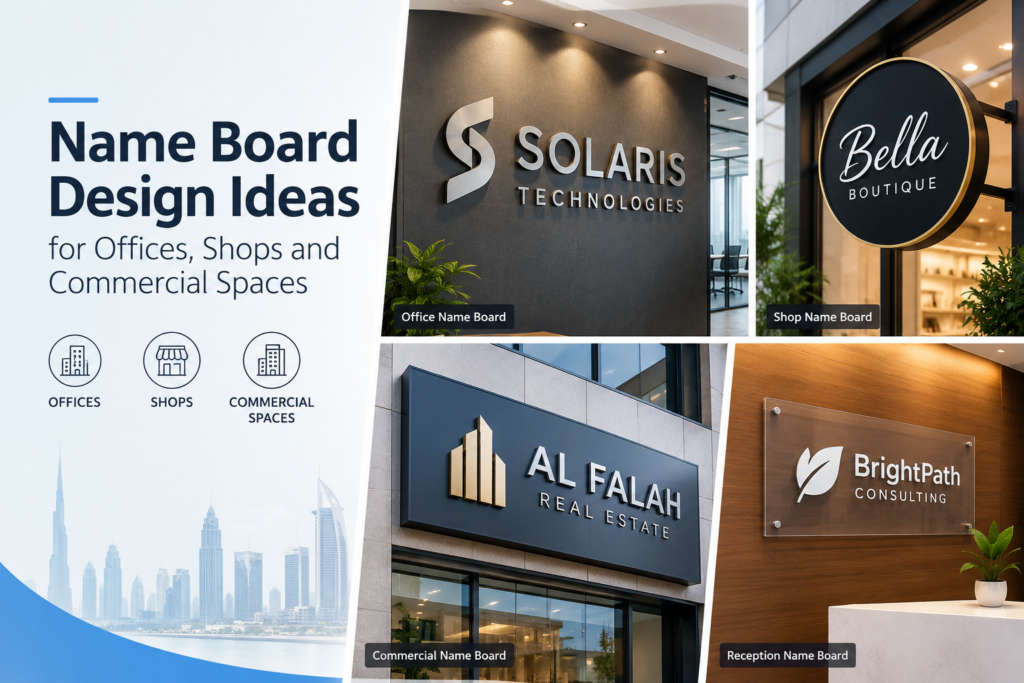
Your business name may be the first thing someone notices before they walk through the door. The right name board design makes that introduction clear, whether it sits behind an office reception, above a Dubai shopfront or at the entrance to a commercial space. Size, colour, material and placement all affect how the finished sign looks in its surroundings.
Instead of choosing a design simply because it looks good in a catalogue, think about your own space. A wide reception wall can give 3D lettering room to stand out, while an evening shopfront may benefit from illumination. Acrylic, metal, raised letters and lighting each create a different result, so the best idea starts with your brand and where the sign will actually be installed.
Start Your Name Board Design With the Location
Before choosing fonts, colours or materials, stand where your customers normally stand.
What do you see?
This simple check can change the whole design.
Look at the Viewing Distance
- A reception sign may only need to work across a lobby.
- A shop name board could be viewed from much farther away.
As viewing distance increases, lettering generally needs enough size and contrast to remain easy to recognise.
Look at the Background
- A beautiful silver letter can disappear against certain grey surfaces.
- Dark lettering may lose contrast against tinted glass.
The wall is part of the design, even though you are not printing it.
Check Day and Evening Conditions
If customers visit after sunset, look at the location at night too. A shopfront that stands out during daylight may become much less noticeable when surrounding businesses switch on their signs.
Office Name Board Ideas That Use the Wall Better
An office name board does not have to look like a rectangular panel attached to a reception wall.
Sometimes the wall itself provides the better background.
1. Raised Company Letters
Mount individual letters and a logo directly onto the reception wall. This approach works particularly well when you have a wide, uncluttered surface. Instead of visually containing the brand inside a box, the lettering becomes part of the interior.
2. Acrylic Logo With Raised Mounting
An acrylic logo can sit slightly away from the wall rather than completely flat against it. The small amount of depth creates natural shadow around the shape. You can use clear, coloured or layered acrylic according to the existing brand identity and interior.
3. Brushed Metal Company Name
A metal name board or individual metal letters can suit reception areas with stone, wood, concrete or neutral finishes. Stainless steel and aluminium are common options for dimensional commercial signage.
4. Backlit Reception Logo
Lighting behind raised letters creates a glow around the logo. This can give a reception wall more visual depth without turning the complete background into an illuminated panel.
Let the Reception Wall Become Part of the Design
One mistake is choosing the board before considering the size of the wall. Imagine a four-metre reception wall with a very small sign in its centre. The company name may be perfectly readable when you stand beside it, yet feel lost when you enter the reception.
Instead of asking only:
“What board size do we want?”
ask:
“How should the brand sit on this wall?”
A wider arrangement of individual letters may work better than a small rectangular board. A vertical logo may suit a narrow feature wall. A horizontal company name could work naturally above a reception desk.
Photograph the whole wall before approving the design. Do not judge it from measurements alone.
Shop Name Board Ideas That Work From the Street
Retail signage has a different job.
People may pass a shop without planning to enter it. The shop sign board needs to make the business easy to identify without requiring someone to stand directly outside the door.
1. 3D Acrylic Letters
Individual acrylic letters can reproduce many brand colours while adding physical depth to the shopfront. They can work for boutiques, salons, cafes, service businesses and other retail settings.
2. Metal 3D Lettering
Metal letters can create a more architectural appearance. Stainless steel and aluminium are commonly used for dimensional signage, with the final finish selected around the brand and facade.
3. Backlit Shop Letters
Instead of illuminating the front of the letters, light can appear from behind them. The resulting halo separates the lettering from the background after dark.
4. Illuminated Sign Box
Not every business needs separate letters. A lightbox keeps the company name, logo and background within one defined shape. This can suit certain shopfronts where a contained sign fits the building better.
Should Your Business Name Board Be Illuminated?
LED lighting can be useful, but adding lights to every business name board does not automatically improve it.
Start with opening hours.
Mainly Open During Office Hours?
A company inside an office tower may receive nearly all visitors during daylight. Good contrast and existing indoor lighting may already give the sign enough visibility.
Open Into the Evening?
Restaurants, salons, shops and other businesses operating later have a different requirement. Their signs still need to work when natural light disappears.
Think About the Type of Illumination
Different designs can use light differently.
- Face-lit letters illuminate toward the viewer.
- Backlit letters create light behind the characters.
- Lightboxes illuminate a larger sign face.
Choose the lighting method as part of the design rather than adding LEDs after everything else has been decided.
Acrylic Name Board Ideas for Commercial Interiors
An acrylic name board gives you several design directions because acrylic can be cut, printed, layered and produced in different finishes.
1 . Clear Acrylic With Printed Branding
Clear acrylic can allow the existing wall colour or texture to remain visible behind the sign. This can work when the background is simple enough to keep the logo readable.
2. Frosted Acrylic
A frosted surface can reduce transparency and give the board a softer appearance. It can also provide greater visual separation where clear acrylic would blend into the background.
3. Layered Acrylic Signage
Using more than one layer creates physical depth.
For example, a backing shape can sit behind raised logo elements.
The layers should support the logo rather than turning a simple identity into an unnecessarily complicated sign.
4. Individual Acrylic Letters
You do not always need an acrylic panel. Cutting the company name or logo into separate pieces can give the wall a cleaner, more open composition.
Metal Name Board Ideas for Business Entrances
Metal gives a company name board a different visual character from printed acrylic.
The finish matters as much as the material.
1. Brushed Stainless Steel
A brushed surface can work well with contemporary reception areas and commercial entrances. Its directional texture also looks different from highly polished metal.
12. Matte Black Letters
Black dimensional lettering can create strong contrast against many pale backgrounds. Always check it against the actual wall rather than assuming black will work everywhere.
3. Brass-Style Lettering
Warm metallic finishes can complement selected hospitality, beauty and commercial interiors. The surrounding materials should guide the decision.
4. Halo-Lit Metal Letters
Raised metal lettering can be combined with rear illumination. The glow helps separate the characters visually from the wall, particularly in lower-light settings.
Choose a Name Board That Works With the Background
Your sign and building should not be designed independently. A commercial sign board that looks excellent against a white design screen may behave completely differently after installation.
On a Dark Facade
Lighter lettering can create useful contrast. Illumination may also be worth considering if the business operates at night.
On a White Wall
Dark colours, selected brand colours or suitable metal finishes can create separation.
On Marble
Marble already contains natural lines and colour variation. Very detailed lettering may compete with the stone pattern. Test the sign against a photograph of the actual slab or wall.
On Wood
Wood brings its own grain and colour. Choose lettering that remains readable instead of selecting another finish that visually disappears into it.
On Glass
Remember that glass does not provide one consistent background. People, furniture, buildings and changing light may all appear behind the sign. Contrast needs extra thought.
Plan Arabic and English Together
A bilingual name board in Dubai should not look as though one language was designed first and the other was added into the leftover space. Arabic and English have different shapes and proportions. Plan both from the beginning.
Think about:
the relative size of each language, alignment, spacing, logo position and the overall width of the sign.
If both names need equal visual importance, test them together at the actual intended size.
This is particularly useful for shopfronts and larger commercial signs where people may only have a short time to read the business name.
Restaurant Name Boards Need Readability First
Restaurant branding can be expressive, but decorative lettering still needs to be readable.
A complicated script may look attractive on a menu and become difficult to recognise from across a road.
1 Simple Dimensional Restaurant Name
Let the restaurant’s logo, facade and interior establish the personality.
The sign itself can remain clear.
2. Halo-Lit Restaurant Lettering
Backlighting can help the restaurant name remain visible during evening hours while retaining the shape of individual letters.
The design should still be tested during daylight because the sign has to work before the lights switch on too.
Salon Name Board Ideas Should Follow the Brand
There is no single font or material that makes a sign suitable for a salon.
Start with the salon’s existing identity.
1. Minimal Raised Logo
If the interior already uses strong colours, patterns or decorative finishes, simple lettering can provide visual balance.
2. Metallic Salon Signage
Selected metallic finishes can work when they already fit the brand palette and surrounding materials.
3. Illuminated Script Logo
If script typography is genuinely part of the brand, dimensional or illuminated lettering can reproduce it on a larger scale.
Avoid choosing script simply because the business is a salon. The sign should look like the company, not a generic category.
Clinic and Professional Office Signs Need Clear Hierarchy
Clinics, consultancies and professional offices may need more than a company name.
That does not mean every piece of information should receive equal prominence.
1. Put the Main Name First
The organisation should be easy to identify as someone approaches.
2. Keep Supporting Details Smaller
A speciality, department or suite number can sit below the main name without competing with it.
3. Repeat the Same Style Inside
If several departments or rooms need signs, continue the same typography, materials and general visual system.
Visitors then see one connected signage system rather than unrelated boards around the office.
Showroom Name Boards Should Not Fight With the Products
Showrooms already contain plenty to look at. Cars, furniture, lighting products, tiles or equipment may occupy most of the customer’s attention. The business signage should establish the company identity without competing with those products.
A clear logo at the entrance or reception can often work better than an oversized wall filled with promotional graphics.
- Let the products remain the products.
- Let the name board identify who is presenting them.
3D or Flat Name Board: Which Fits Your Space?
Both options have useful applications.
|
Feature |
Flat Name Board |
3D Name Board |
|
Physical depth |
Minimal |
Raised from surface |
|
Natural shadow |
Limited |
More noticeable |
|
Individual letters |
Not always |
Common |
|
Printed information |
Easy to include |
Better kept selective |
|
Illumination |
Can use lightbox formats |
Face-lit or backlit options |
|
Common setting |
Doors, walls, information area |
Reception walls, facades, shopfronts |
The better choice depends on where the sign sits and what you want people to notice.
Decide What Belongs on the Main Name Board
A larger board does not mean you should fill every available centimetre.
Your main sign might only need:
Company Name
Logo
Short Descriptor
Move other information somewhere more appropriate.
- Opening hours can appear near the entrance.
- A phone number can go on window graphics.
- Services can appear on another panel.
- Current offers can use temporary promotional signage.
Trying to combine the company name, seven services, telephone number, website, social accounts and opening hours on one shop sign board can weaken the information people actually need first.
Take One Step Back Before You Approve the Design
Here is one simple thing you can do before production.
- Take a photograph from where customers are likely to see the sign.
Not a close-up.
- For an office, take the photo from the reception entrance or lift lobby.
- For a shop, photograph the facade from the opposite pavement where possible.
- For a showroom, stand near the main entrance.
Then place the proposed sign approximately onto that photograph.
- Does it still look large enough?
- Can you recognise the company name?
- Does the colour separate from the wall?
- Does another object block it?
A design can look perfectly proportioned on a computer screen and surprisingly small once placed on a large commercial facade.
Check the Installation Area Before Production
Good company signage also depends on what happens after printing or fabrication. Before confirming the order, provide clear information about the installation location. Useful details include the wall dimensions, surface material, installation height, indoor or outdoor position and nearby electrical access when lighting is required.
For exterior commercial signage in Dubai, building management, mall management or relevant authority requirements may apply depending on the location and type of installation. Check these requirements before producing a sign that may later need changes.
Make Your Business Name Easy to Recognise
The strongest name board design is not necessarily the one with the most expensive material or brightest lighting. It is the one that works where the business actually operates.
A reception wall may suit dimensional acrylic lettering. A shop that trades into the evening may benefit from illumination. A corporate entrance could work better with brushed metal. A showroom may only need a clean logo that does not compete with the products around it.
At Zahrat Al Madina Printing, we produce custom name boards and business signage for offices, shops and commercial spaces across Dubai. Share a clear photo of your installation area, approximate dimensions, logo and preferred style with our team. We can use the actual location as the starting point for your sign rather than choosing a design in isolation.
Frequently Asked Questions
What Is The Best Name Board Design For An Office?
The best design depends on the reception wall, available area and company identity. Raised acrylic letters, metal lettering and backlit logos are among the options for office reception areas.
Which Material Is Suitable For A Shop Name Board?
Acrylic, aluminium and stainless steel are among the materials used for commercial signage. The right option depends on the shopfront, required finish, installation location and whether illumination is needed.
Is Acrylic Suitable For A Company Name Board?
Yes. Acrylic can be cut, layered, printed or produced as individual letters. Different colours and finishes also make it useful for many indoor commercial applications.
Should A Shop Name Board Have Lighting?
Not Always. Lighting becomes more important when the business operates after dark or the sign needs stronger nighttime visibility. Daytime-only locations may not require an illuminated board.
What Is The Difference Between A Flat And 3d Name Board?
A flat sign has little physical depth, while a 3D sign uses raised lettering or other dimensional elements. The raised construction can create natural shadow and can also support different illumination methods.
Can I Have Arabic And English On The Same Name Board?
Yes. Arabic and English can be incorporated into one design. Both languages should be planned together so their scale, spacing and positioning work across the complete sign.
What Colour Should I Choose For A Business Name Board?
Start with your existing brand colours, then check their contrast against the installation surface. A colour that works on a white background may not remain visible against glass, marble or a similarly coloured facade.
How Large Should A Shop Name Board Be?
There is no single size for every shop. Consider the available facade, viewing distance, logo proportions and any building or location restrictions before deciding the dimensions.
Can A Company Name Board Be Installed On Glass?
Certain signage systems can be used with glass, but the mounting method, sign weight, visibility and existing glass construction need to be considered before installation.
Do business signs in Dubai require approval?
Requirements can depend on the sign type, location and property. Exterior signage may be subject to building, mall or relevant authority requirements, so confirm what applies to your premises before production.