
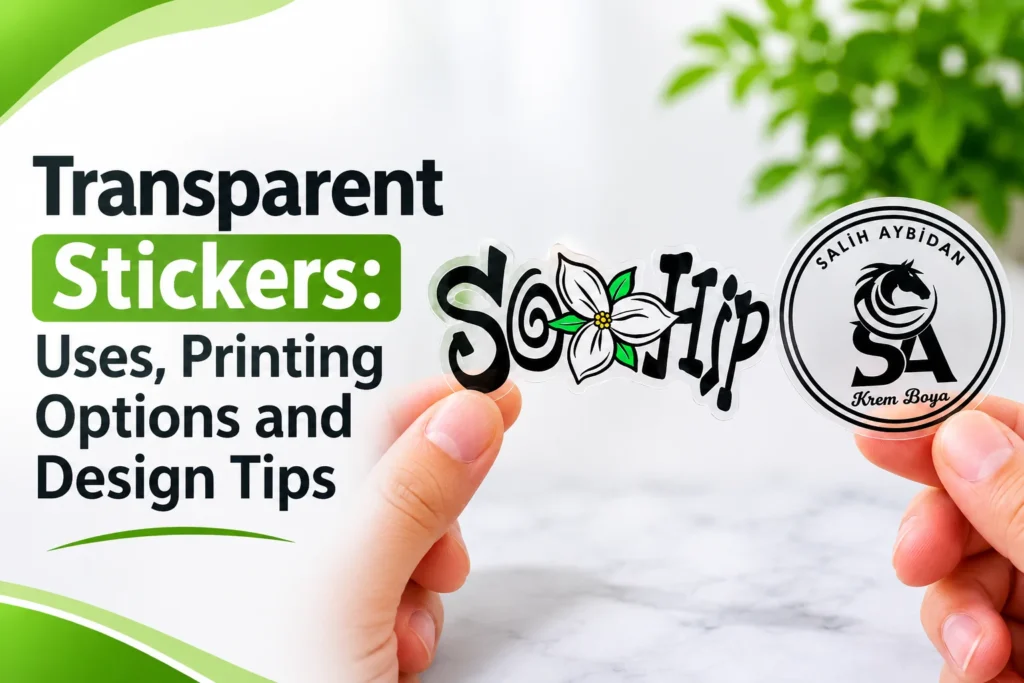
A clear glass bottle with a printed logo, a shop window displaying business details, or a gift box with a small branded label. Transparent stickers appear on all these products, often without covering the surface underneath. Businesses use transparent stickers to add logos, text and decorative designs to packaging, glass and promotional materials. Their clear background allows the original surface to remain visible, creating a different appearance from traditional white labels.
In Dubai, retailers, restaurants, cosmetic brands and event organisers use clear stickers for various branding applications. However, the final result depends on the sticker material, printing method, ink and artwork. A design that looks bright on white packaging may become difficult to read on dark glass. Similarly, a sticker intended for indoor packaging may not withstand prolonged exposure to outdoor sunlight. Choosing suitable materials and preparing the artwork correctly helps produce clear, readable stickers for the intended application.
Transparent Stickers for Branding and Packaging
Transparent stickers use clear adhesive film rather than ordinary white sticker material. The film allows light to pass through unprinted areas, leaving the surface beneath visible. Businesses can print coloured graphics, logos, white lettering and product information on the material.
For example, a skincare company may apply a clear label to a bottle so customers can see the contents. A café may use a transparent logo sticker on takeaway packaging without covering the box design.
The finished appearance depends on the film and ink. Glossy clear stickers often blend more closely with smooth glass, while matt films create a softer appearance. Transparent stickers are not completely invisible. Their edges, adhesive and printed areas may remain noticeable under certain lighting conditions.
Popular Uses of Transparent Stickers in Dubai
Clear stickers work across several industries because businesses can apply them to different smooth surfaces.
Product Packaging and Bottle Labels
Cosmetic brands, perfume businesses, beverage companies and retailers use transparent labels on bottles, jars and containers. These labels display product names, logos, ingredients and other information while keeping the packaging colour visible. Clear polypropylene and polyester films are common choices for product labels because selected grades offer moisture resistance and durability. For food-related packaging, businesses should confirm that the sticker material and adhesive meet the requirements of the intended application.
Shop Windows and Glass Doors
Retail stores, offices, salons and cafés use transparent window stickers to display business information without covering large sections of glass.
Common applications include:
- Company logos on entrance doors
- Opening hours and contact details
- Promotional messages on shop windows
- Decorative designs on glass partitions
- Directional information inside offices
Clear stickers allow uncovered areas of glass to remain visible. However, large printed graphics can still reduce visibility through the window.
Restaurant and Cafe Packaging
Restaurants, bakeries and cafes use transparent logo stickers on takeaway boxes, dessert containers, cups and packaging sleeves. These stickers add business information without hiding the product or packaging design. For chilled drinks and refrigerated products, moisture-resistant films and compatible adhesives help maintain adhesion when condensation develops.
Promotional Merchandise
Businesses apply clear logo stickers to laptops, notebooks, water bottles, gift boxes and promotional products. They are commonly used for exhibitions, corporate events and marketing campaigns. The material should match the product’s intended use. A sticker suitable for a notebook may not withstand repeated washing on a reusable bottle.
Event and Gift Packaging
Event organisers use custom transparent stickers for invitation envelopes, wedding favours, gift bags and branded giveaways. They can print names, event dates, logos and decorative artwork while leaving the original packaging visible.
Materials Used for Transparent Sticker Printing
The material affects sticker clarity, flexibility, moisture resistance and durability. Different applications require different films.
Clear Vinyl Stickers
Clear vinyl is commonly used for window graphics, promotional stickers and general business branding. Its flexibility makes it suitable for many smooth surfaces. Some vinyl films are designed for outdoor applications, although their resistance to sunlight and heat depends on the specific product.
Clear Polypropylene Labels
Clear polypropylene, also called PP or BOPP, is widely used for product packaging. It offers good clarity and moisture resistance, making it suitable for many bottles, jars and retail containers. Businesses frequently use it for cosmetic products, beverages and personal care packaging.
Clear Polyester Stickers
Clear polyester, or PET, provides good dimensional stability and durability. It is commonly used for product identification, equipment labels and packaging that requires a stable film.
Clear Polyethylene Labels
Clear polyethylene, or PE, offers flexibility for certain curved or squeezable containers. It can accommodate some packaging movement without the stiffness of other films. The supplier should confirm that the film and adhesive suit the container material and shape.
Printing Options for Transparent Stickers
The printing process influences colour appearance, production quantity and available finishing options.
Digital Sticker Printing
Digital printing suits customised designs, smaller production runs and orders containing different artwork versions. Businesses often use it for promotional labels, packaging samples and product launches. It can reproduce detailed graphics and multiple colours without the same setup requirements as some conventional methods. However, not every digital printer supports white ink.
UV Sticker Printing
UV printing uses ultraviolet light to cure specially formulated inks. Compatible UV printers can print coloured graphics onto transparent films, and some support white ink layers. This method is suitable for various custom sticker applications, provided the ink and film are compatible.
Screen Printing
Screen printing works well for bold graphics, solid colours and certain specialised sticker designs. It can provide strong colour coverage for artwork containing a limited number of colours. However, production setup may make it less economical for small quantities.
Flexographic Printing
Flexographic printing is commonly used for large quantities of labels supplied on rolls. It is particularly useful for businesses that need repeated product labels for automated packaging lines. The most suitable printing method depends on the sticker size, artwork, material, and order quantity.
White Ink Printing on Transparent Stickers
White ink affects how colours appear on clear sticker material. Standard CMYK printing on transparent film can produce translucent colours. The surface underneath may show through the printed artwork.
For example, a red logo may look bright on a white bottle but appear darker when applied to black packaging.
White ink helps control this effect.
Clear Stickers Without White Ink
When coloured ink prints directly onto transparent film, light can pass through parts of the design. This creates a translucent appearance that may suit decorative graphics or light-coloured packaging. However, pale colours and small lettering can become difficult to read on darker surfaces.
Clear Stickers With White Ink
Printers can apply white ink behind selected coloured areas to create an opaque base. This technique, known as white underprinting, helps printed colours remain visible against dark or coloured backgrounds. White ink can also create visible white lettering and logos directly on transparent film.
Businesses often request white ink for:
- Company logos on dark glass bottles
- White lettering on clear packaging
- Colourful labels on tinted containers
- Product information requiring stronger contrast
- Detailed graphics on coloured surfaces
Before ordering a large quantity, test the printed design on the actual product or packaging.
Glossy, Matt and Custom-Cut Sticker Finishes
Finishing options affect both the appearance and application of transparent stickers.
Glossy Transparent Stickers
Glossy films have a reflective surface and often create a glass-like appearance. They work well for bottles, jars, windows, and retail packaging. However, reflections may affect readability under strong lighting.
Matt Transparent Stickers
Matt finishes reduce reflections and create a softer appearance. They may suit decorative packaging and office branding. Matt films generally appear less invisible than high-clarity glossy materials.
Die-Cut Stickers
Die-cut stickers follow the outline of a logo, symbol or custom shape. Businesses use them for branded merchandise, promotional giveaways and decorative designs.
Kiss-Cut Stickers
Kiss-cut stickers are cut through the sticker film while leaving the backing sheet intact. This makes them easier to peel and allows multiple designs to appear on one sheet.
Roll Labels
Roll labels suit businesses that regularly label bottles, jars and product containers. They are particularly useful for larger packaging quantities and compatible automated labelling equipment.
Design Tips for Transparent Stickers
Clear sticker printing requires careful artwork preparation because the colour and texture of the application surface influence the finished design.
1. Keep the Background Transparent
Prepare the artwork with a transparent background wherever the original surface should remain visible. A white background in the design may print as an opaque area if the printer uses white ink. Check the artwork settings before submitting the file.
2. Choose Colours That Remain Visible
Light-coloured text may disappear against pale packaging, while dark graphics may blend into tinted glass. Select colours after considering the surface where the sticker will be applied. A printed sample gives a more accurate impression than a digital preview.
3. Use White Ink for Better Contrast
White underprinting helps coloured graphics remain visible on dark surfaces. You can apply white ink behind selected elements rather than the entire design. This allows some areas to remain transparent while keeping important text readable.
4. Keep Lettering Clear
Avoid placing too much information on a small sticker. Very thin fonts and closely spaced lettering may become difficult to reproduce or read. Use suitable font sizes and leave enough space between design elements. For product labels containing regulated information, check any applicable text-size requirements.
5. Supply High-Resolution Artwork
Vector artwork works well for logos because it can be resized without losing detail. AI, EPS and suitable PDF files are common options. For photographs and raster graphics, provide high-resolution files at the required printing dimensions. Avoid enlarging small images because this can reduce print quality.
6. Allow Space Around the Edges
Keep important text away from the cutting line. If the design extends to the edge, include the bleed required by the printing company. Cutting tolerances vary, so confirm the supplier’s specifications before finalising the artwork.
7. Confirm the Printing Direction
Some transparent window stickers are applied inside the glass but viewed from outside. These applications may require reverse printing and a specific arrangement of ink layers. Tell the printing company which side of the glass will receive the sticker.
8. Test the Design Before Bulk Printing
Apply a sample to the actual bottle, box, window or container. Check the colours, text clarity, adhesive and overall appearance. Testing is particularly useful for dark packaging, curved containers and outdoor applications.
Transparent Stickers vs. White Stickers
Transparent and white stickers both support business branding, but their backgrounds create different results.
Transparent Stickers
Transparent stickers allow the surface underneath to remain visible through unprinted areas. They work well on glass bottles, cosmetic packaging, shop windows and promotional products. However, the surface colour can affect printed graphics. White ink underprinting may be necessary when the design needs stronger contrast.
White Stickers
White stickers have an opaque background that covers the surface underneath. This provides a consistent base for logos, text and coloured graphics. Businesses commonly use them for product labels, shipping boxes, food packaging and promotional materials. They are especially useful when labels contain detailed information or need to remain readable on different coloured surfaces.
For Dubai businesses, transparent stickers suit applications where the product or surface should remain visible. White stickers are often more suitable when consistent colour reproduction and readability are the main priorities.
Transparent Stickers for Outdoor Use in Dubai
Dubai’s strong sunlight, high temperatures and dusty conditions can affect sticker performance.
A transparent sticker designed for indoor packaging may not remain suitable for prolonged outdoor exposure. For exterior glass, shop windows and other outdoor applications, select materials, adhesives and printing inks rated for the expected conditions.
UV-resistant printing systems can help reduce fading, while suitable adhesives support attachment under high temperatures. The material’s water resistance should also match the application. A waterproof film does not automatically guarantee long-term resistance to sunlight or heat. For outdoor branding, ask the printing company about the expected service life and recommended cleaning methods.
Applying Transparent Stickers to Glass and Packaging
Dust, grease and trapped air can affect the appearance of clear stickers.
- Before application, clean the surface and allow it to dry completely.
- Remove fingerprints, oil and other residue that may interfere with adhesion.
- Peel the backing carefully and position the sticker before pressing it into place.
- Apply even pressure to reduce trapped air.
For larger graphics, follow the installation method recommended for the selected film. Some materials support wet application, while others require dry installation. Avoid touching the adhesive unnecessarily.
Transparent stickers can reveal bubbles and fingerprints more easily than opaque labels, so careful application helps produce a cleaner appearance.
Ordering Custom Transparent Stickers in Dubai
Before ordering custom transparent stickers in Dubai, consider the surface, design and intended use. A clear label for a perfume bottle requires different materials from a promotional sticker for an exterior shop window.
Confirm these details with the printing company:
- Sticker Size: Select dimensions suitable for the product or surface.
- Material: Choose vinyl, polypropylene, polyester or another compatible film.
- Artwork: Supply clear files with correctly prepared transparent areas.
- White Ink: Specify whether the design needs opaque text or colour backing.
- Finish: Choose glossy, matt or another available finish.
- Adhesive: Confirm permanent or removable adhesive requirements.
- Quantity: Select individual stickers, sheets or rolls.
- Application Conditions: Mention outdoor exposure, moisture, heat or curved surfaces.
The cost of transparent sticker printing depends on material, size, quantity, printing method, white ink coverage and finishing.
A printed sample is particularly useful when the final appearance depends on the colour or texture of the application surface.
Custom Transparent Sticker Printing for Dubai Businesses
Transparent stickers allow businesses to display logos, product information and promotional designs while keeping much of the original surface visible. They suit bottles, jars, shop windows, retail packaging and branded merchandise.
However, clear material alone doesn’t guarantee a good printed result. Artwork preparation, ink opacity, adhesive compatibility and application conditions all influence the final appearance.
For businesses planning transparent sticker printing in Dubai, selecting the appropriate film, printing method and finish helps create stickers suited to their products and branding requirements.
Frequently Asked Questions
Are Transparent Stickers Waterproof?
Many clear vinyl, polypropylene and polyester stickers offer water resistance. However, performance depends on the material, adhesive and ink. Not every transparent sticker is suitable for repeated washing or outdoor exposure.
Can Transparent Stickers Have White Text?
Yes. Professional printers equipped with white ink can print white lettering and logos directly onto transparent sticker material.
Do Transparent Stickers Work On Dark Bottles?
Yes. White ink underprinting helps coloured graphics and text remain visible on dark or tinted bottles.
Can Transparent Stickers Be Used Outdoors In Dubai?
Yes, provided the film, adhesive and ink are suitable for outdoor sunlight and temperatures. Indoor materials may fade or deteriorate more quickly.
Can Transparent Stickers Be Removed From Glass?
Some transparent stickers use removable adhesives, while others are intended for permanent attachment. Removal difficulty and adhesive residue depend on the material, surface and length of installation.